

Budget Priorities Amid Global Uncertainty
The Indian government, led by Prime Minister Narendra Modi, has unveiled its annual budget for 2026-2027, aiming to sustain economic growth despite volatile global markets and ongoing trade tensions.
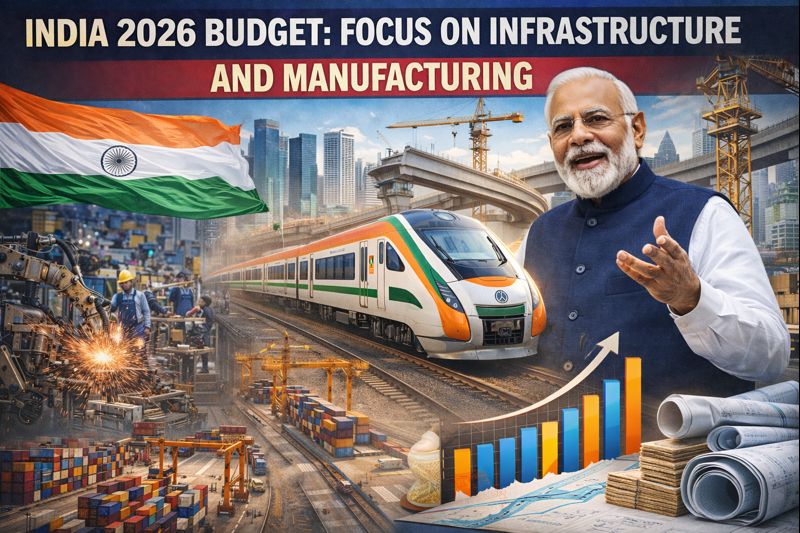
Finance Minister Nirmala Sitharaman presented the budget in Parliament on Sunday, prioritising infrastructure and domestic manufacturing. The total expenditure is projected at $583 billion, reflecting a strong push for long-term economic resilience.
Economic Context and Global Trade Pressures
India’s economy has navigated challenges, including 50% tariffs imposed by the United States on Russian oil imports. The government has offset some of these pressures through trade agreements, such as the recent pact with the European Union.
Despite these hurdles, India remains one of the fastest-growing major economies in the world. The 2026-27 budget projects GDP growth of 6.8–7.2%, slightly below this year’s forecast of 7.4%, but still above World Bank estimates.
Infrastructure and Manufacturing Investments
To support growth, the government plans to invest ₹12.2 trillion ($133 billion) in infrastructure, up from ₹11.2 trillion ($122 billion) last year.
The budget also targets seven strategic manufacturing sectors:
-
Pharmaceuticals
-
Semiconductors
-
Rare-earth magnets
-
Chemicals
-
Capital goods
-
Textiles
-
Sports goods
Additionally, the government aims to promote niche industries, including artificial intelligence, to strengthen India’s position in global supply chains.
Fiscal Responsibility and Debt Management
Despite increasing spending, the government plans to reduce the federal debt-to-GDP ratio from 56.1% to 55.6% and lower the fiscal deficit from 4.4% to 4.3% of GDP.
Finance Minister Sitharaman emphasized that the budget focuses on long-term resilience rather than populist giveaways, marking a shift from last year’s measures, which included tax cuts for salaried individuals.
Challenges and Market Reactions
Prime Minister Modi highlighted that the nation is “moving away from long-term problems to tread the path of long-term solutions”, stressing that predictable policies foster domestic and international trust.
The government continues to face challenges, including:
-
Manufacturing contribution under 20% of GDP, below the target of 25%
-
A declining rupee value, weakened due to foreign investors selling $22 billion in Indian equities since January 2025
Market analysts described the budget as “without fireworks – neither strongly positive nor negative”, reflecting a cautious approach in a turbulent global economic environment.